
日本・アフガニスタン日本語学校パスウェイズ2027年度募集
Application is open from Friday, 17th July to Monday, 3rd August, 2026
If you are interested in applying, please read this web page carefully and apply.
Before you make your application, please refer to Programme Guidance 2027 for JALP to understand the details of the program.
Also, please check Frequently Asked Questions when preparing your application.
What is Japan-Afghanistan Language School Pathways (JALP)?
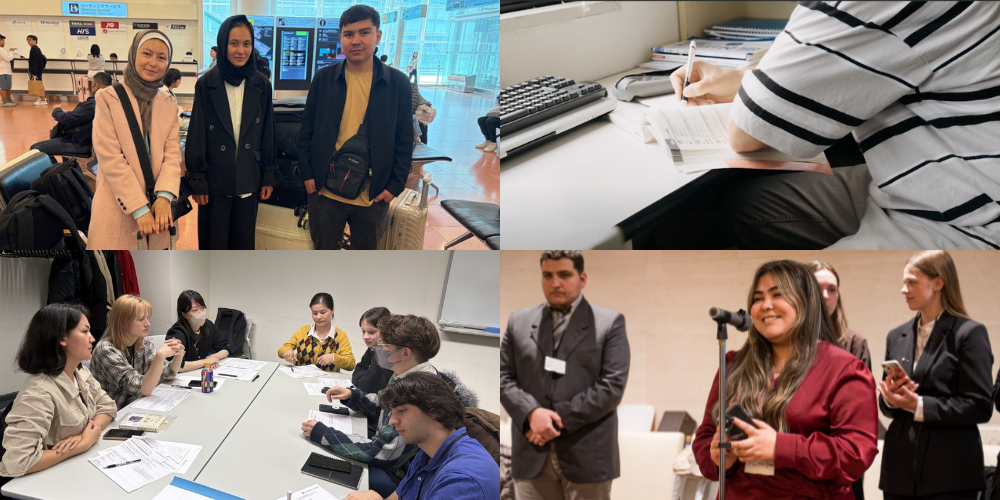
Japan-Afghanistan Language School Pathways (JALP) offers an opportunity for Afghan youth to study Japanese in private language schools across Japan for two years. The program targets those in Afghanistan who seek evacuation to Japan or have fled to other countries after August 2021. From 2022 to 2026, 33 Afghan students were admitted to Japan through this program with the support from private language schools, supporting companies, NGOs, individuals and local communities. Selected students study tuition-free in the two-year program, which is considered the minimum required to reach a level of Japanese necessary to enter university or find employment in Japan.
For April 2027 recruitment, we will offer around 20 scholarship opportunities for Afghan applicants to this program.
Program Overview
Recruited students will be placed in one of the Japanese language schools across Japan.
The program will provide the following:
・Support for visa issuance and residence permit
・Pre-departure Japanese language classes before traveling to Japan
・Airfare to Japan
・Two years of Japanese language education offered by one of the partner Japanese language schools of PJ (worth USD15,000)
・Stipend for the first six months
・Introduction of part-time job opportunities and housing
・Educational and career consultation every three months to enter university or find employment
*Please note that students are expected to work part-time to cover their rent and living expenses.
*After completion of the program, students are expected to enter universities or find employment and extend their legal status in Japan.
We will organize online Info Sessions on the dates below
23rd July Thu 12:30 PM (Afghan time)
Please check Frequently Asked Questions page for the Info Session presentation slide.
Future Prospects
If you are a high school graduate …
After you improve your Japanese language skills and obtain sufficient scores in the
Examination for Japanese University Admission for International Students (EJU), you can apply to universities in Japan. The program will offer regular consultation on the preparation for this exam, but scholarships for universities are not guaranteed and it is your responsibility to apply for financial aid. After graduating from a university or vocational school, you will have a good chance of finding a job in Japan. When you find employment, you can obtain a work visa in Japan.
If you are a university graduate …
Once you complete the two-year course, you can apply for a master’s degree by obtaining a scholarship. It is also possible to find employment and obtain a resident status with work permit. A high level of Japanese is normally required to find a job in Japan, even if one is fluent in English.
Eligibility
- Must be an Afghan national
- Must reside in Afghanistan and seek evacuation to Japan or fled to other countries after August 2021
- Must be single without accompanying families (The Japanese government does not issue visas for accompanying family members for language students.)
- Must have completed 12 years of school education, or be expected to complete 12 years of school education by March 2027 (This is a requirement to obtain a student visa in Japan.)
- If you are a high school graduate, you must be 26 years old or younger; if you are a university graduate, you must be 33 years old or younger.
- Must have studied or been studying Japanese.
- Must agree to work part-time at an entry-level job to cover your own living expenses in Japan.
- Must NOT have a financial obligation to support family members (Students should expect part-time work to cover only their own living expenses, and not to support their families.)
- Must be able to submit the following documents:
a) Document describing your refugee background (e.g. letter explaining the difficulty of staying in or returning to your home country, issued by an NGO or an expert. If this cannot be obtained, the candidate can write his/her own statement.)
b) Passport copy (If you do not currently have a valid passport, you must renew it by January 2027 or obtain one newly by October 2026)
c) High school graduate certificate or equivalent document (*GED will be accredited as an equivalent certificate.)
d) High school transcript for grades 10-12 or equivalent document
e) (If you are a university student or graduate) University certificate and transcript for registered terms
f) Recommendation letter (*This letter should not be written by family members, relatives or friends. )
*Please check Frequently Asked Questions when preparing your application.
Supporting Organizations
Pathways Japan – Implementing Organization
It is a Japanese non-governmental and non-profit organization, supporting people with refugee experience abroad to be admitted to Japan and get higher education and employment. PJ succeeded Language School Pathways Program from Japan Association for Refugees (JAR) on 1st July 2021.
Japanese Language Schools – Host Organizations
In 2027, around ten language schools are planning to admit youth with refugee backgrounds to learn Japanese language for 2 years from April 2027 to March 2029.
Japan ICU Foundation – Funding and Implementing Organization
The Japan ICU Foundation (JICUF) is a US non-profit organization based in New York. Since 2016, JICUF has partnered with JAR, and later with PJ, to administer the Syrian Scholars Initiative (SSI), a scholarship program for Syrian students to study at International Christian University (ICU) in Tokyo, Japan. JICUF currently provides funding to administer Language School Programs for Syrians, Afghans and Ukrainians. It also manages Japan Education Pathways for refugee-background youth living in Japan to access a scholarship to study at universities in Japan.
Application Timeline
23(Thu) Jul 17:00-18:30 JST(12:30 Afghan time) | Online Info Session |
| 17(Fri)Jul-3(Mon) Aug | Application Period |
| 4 (Tue) Aug– 17 (Thu) Sep 2026 | Document screening |
| 18(Fri)Sep 2026 | Announcement of Document screening result (first screening) |
| 19(Sat) 20(Sun) 2026 (Planned) | Trial Japanese language classes (online) |
| 21(Mon)Sep-2(Fri)Oct 2026(Planned) | Interview (online) by Pathways Japan (second screening) |
| 8 (Thu) Oct 2026 (Planned) | Announcement of second screening result |
| 23(Fri)Oct-30(Fri) Oct | Interview (online) by Japanese language schools (third screening) |
| 6 (Fri) Nov 2026 or later | Announcement of final results |
*Due to the high number of applications received, the selection process is taking longer than originally anticipated. Please note that the announcement of first round results will be sent later than initially scheduled. The revised schedule is highlighted in yellow above. Thank you for your patience and understanding.
Note: Policy Change Regarding the Required Japanese Language Proficiency
The Government of Japan has recently introduced a new requirement for students enrolling in Japanese language schools from October 2026 onward.
However, if you have a university certificate issued in the countries designated by the Government of Japan in the list here, the A1 certificate described below will not be required.
So, for those of you who do not possess a university certificate issued in the countries listed above, please follow the instructions below.
Under this policy, applicants must demonstrate Japanese language proficiency equivalent to CEFR A1 or higher at the time of the entrance assessment. This requirement also applies to applicants for the Pathways Japan program.
The assessment will be conducted by the Japanese language school during the admission interview. Applicants who are assessed as not yet having reached the required A1 level will need to continue studying Japanese and may be asked to postpone their enrollment until July 2027 or April 2028.
Steps After Selection
| Between 8 Oct and mid Nov 2026 | Application for a school and residence status in Japan |
| Mid Nov 2026 – Mar 2027 | Preparatory Japanese online classes |
| Last week of Mar 2027 | Travel to Japan |
| Second week of Apr 2027 | School starts |
How to Apply
Application Period: Friday, 17th July to Monday, 3rd August, 2026
▶ Application Form
Before you make your application, please refer to Programme Guidance 2027 for JALP to understand the details of the program.
Also, please check Frequently Asked Questions when preparing your application.